Investing During a Market Crash: What the Data Really Shows

Table of Contents

    Is It Safe to Invest During a Market Crash?

    Baron Rothschild an 18th-century British nobleman and member of the Rothschild banking family quoted -“Buy when there’s blood in the streets, even if the blood is your own.” Rothschild made a huge fortune buying in the panic that followed the Battle of Waterloo against Napoleon. The great value investors of all time like Benjamin Graham, Warren Buffet and many more have made most of there fortune during the Bear Market. A Bear Market is a period during which the markets fall 20% or more from the recent high.


    Why do people panic during a stock market crash?

    For people who are new to investing, they are scared that the market may go further down and hence, might not be the right time to invest. The people who have investments try to exit and enter at a better price. However, the problem is that even the most experienced investors fail to time the market correctly and repeatedly. People planning to invest in the stocks at the bottom-most price would probably fail most of the times. The best approach is to buy when stocks are available at cheap valuations and not to find the bottom.

    Is it worth to invest during a market crash?

    Ironically during a stock market crash, investors don’t make rational decisions. They tend to be emotional hence they end up selling in panic. An intelligent investor invests more when the valuations are attractive. When investing at attractive valuations over 5-10 years, the returns generated will be usally high. We wanted to illustrate how the markets have performed post such deep corrections and have analysed data from 2000’s when the market has corrected by more than 20%. The below graphs show the growth of an initial investment of ₹ 1,00,000 when the markets corrected by 20% over 5years, 7years and 10years.
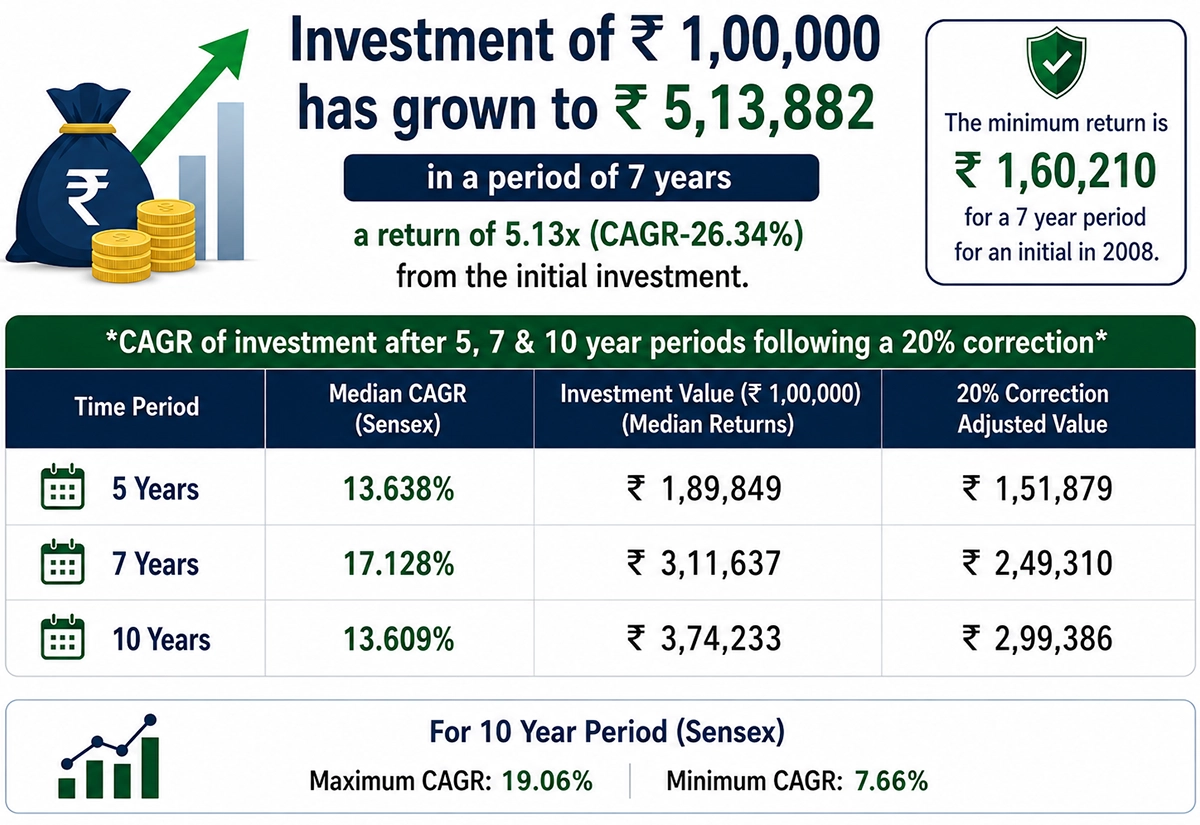
    Investment of ₹ 1,00,000 has grown to ₹ 5,13,882 in a period of 7 years, a return of 5.13x (CAGR-26.34%) from the initial investment. The minimum return is ₹ 1,60,210 for a 7 year period for an initial in 2008.
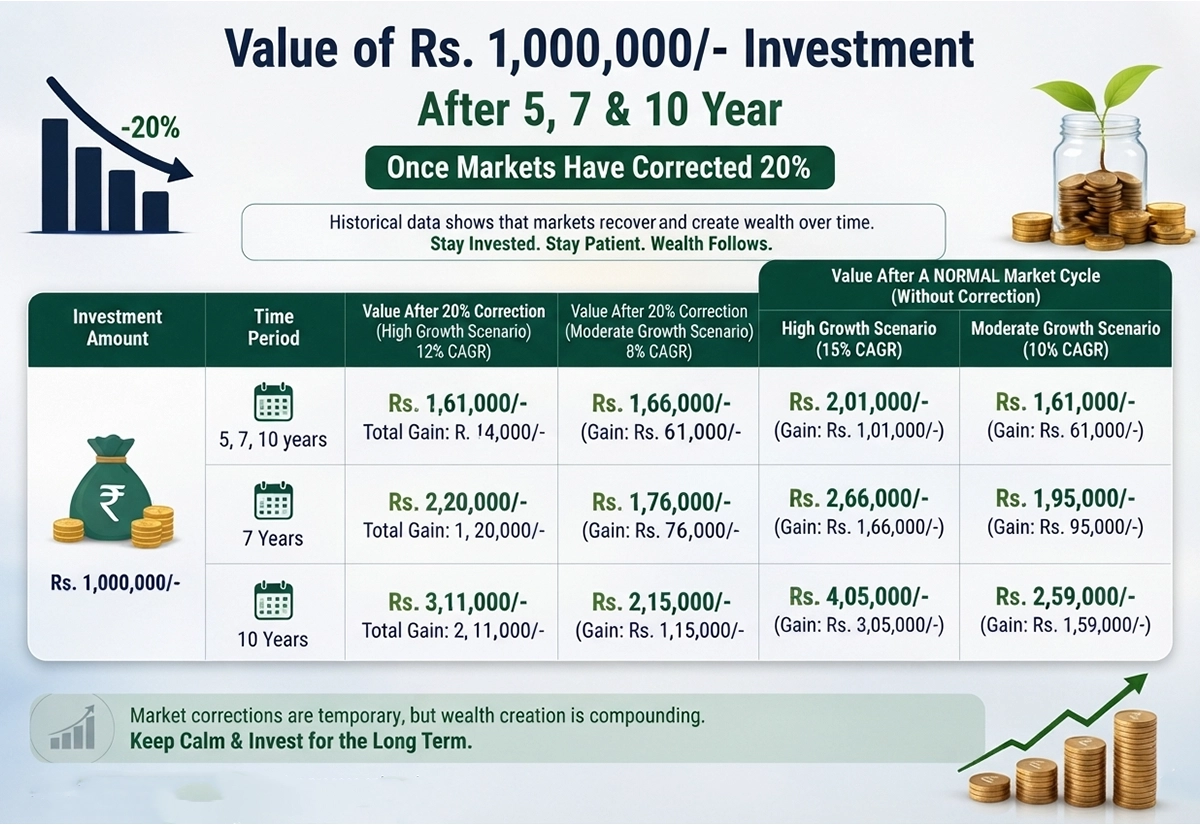
    The median returns for Sensex for 5, 7 & 10 years periods are 13.638%, 17.128% & 13.609% respectively. The maximum CAGR for 10 year period is 19.06% and minimum CAGR for 10 year period is 7.66%.

    The twin forces of fear and greed can mislead you and unsettle your investments. One should not panic and sell in fear during a stock market crash, nor should one get tempted by the above numbers and start investing aggressively.

    Importance of a financial plan and asset allocation strategy

    Prudent measures help you during turbulent times like a stock market crash. The twin friends of an investor are a financial plan and an investment policy statement. A financial plan is the foundation of the building called ‘financial life’; the stronger the foundation, the higher the building. And an investment policy statement illustrates the right asset allocation matrix that is suitable to achieve the goals illustrated in your financial plan after considering your risk profile and individual circumstances. If you already have one, stick to your plan and the strategies illustrated in the investment policy statement. If you don’t, it’s time to connect with a financial planner who can help you build one.

    Get a FREE consultation call with a SEBI Registered Fee Only Financial Planner to understand how a financial plan can help you achieve your financial goals and aspirations.

    Calendar Icon Book Your Free Introductory Call

    Recent Blogs

    7 Steps to Choose the Right Investment Products for Your Financial Goals

    Confused about how to choose investment products? Follow these 7 expert-backed steps to align your investments with your financial goals and risk profile.

    Learn More

    Investing During a Market Crash: What the Data Really Shows

    Should you invest during a stock market crash? See historical Sensex data on returns post-crash and learn why panic-selling hurts investors most.

    Learn More

    Dynamic Asset Allocation: What It Is & Why It Works

    What is dynamic asset allocation and how does it work? See how a P/E-based equity-debt strategy outperformed the Sensex by up to 250% since 1999.

    Learn More

    Understanding Wills: Elements, Types & Why They Matter

    What makes a will legally valid in India? Learn its essential elements, types, importance, and what happens to your estate if you die without one.

    Learn More

    Should You Prioritize Insurance Before Investing?

    Confused about whether to buy insurance or start investing first? Learn why risk management through life, health, and disability cover should come before investments.

    Learn More

    Are Index Funds the Right Choice for You?

    Wondering if index funds are right for you? Learn why chasing top-performing mutual funds fails and how index funds simplify long-term investing.

    Learn More

    Goals Based Investing vs Market Volatility: A Complete Guide

    How does a goals based investment approach help during market volatility? Learn why linking investments to your goals beats reacting to market swings.

    Learn More

    The Right Way to Calculate Your Life Insurance

    How much life insurance do you really need? Learn the Income Replacement and Need Based methods to calculate the right cover for your family.

    Learn More

    REITs Explained: Types, Taxation & How to Invest

    What are REITs and how do you invest in them in India? Learn types, tax rules, pros and cons before adding real estate exposure to your portfolio.

    Learn More

    Right Time to Buy Your Dream House: A Complete Guide

    When is the right time to buy your dream house in India? Explore 4 key factors — economic conditions, interest rates, market trends, and finances.

    Learn More

    The Right Time to Invest During a Market Correction

    We are all shaken, shaken by the ferocity of the fall in the stock markets. Never have we seen a correction of this magnitude in such a short period.

    Learn More

    Why Stock Markets Will Remain Volatile?

    The reason why stock markets fluctuate revolves around the theory of demand and supply. If more people want to buy a stock, its market price will increase.

    Learn More

    What Is a Super Top-Up Health Insurance Policy and How Does It Work?

    Base Policy and Super Top Up Policy are two commonly used options while taking Health Insurance. Health insurance is an important tool to safeguard your financial well-being against unexpected medical expenses. As medical treatments become more expensive

    Learn More

    Limited Pay vs Regular Pay — Which Life Insurance Premium Option Is Right for You?

    Limited pay vs regular pay – it is easy to get confused between options for your life insurance premium payment. While Life insurance plays a crucial role in securing the financial future of your loved ones.

    Learn More

    What Should You Do With Your Life Insurance Policy?

    In Indian families, pressure to buy traditional life insurance policies can be strong and multifaceted. Parents often play the “security card,” emphasizing the importance of safeguarding their child’s future and highlighting potential future burdens or painting a picture of an uncertain future without the policy.

    Learn More

    Comprehensive Guide on Home Loan Overdraft Facility

    Imagine a financial tool that combines the stability of a home loan with the flexibility of an overdraft account – that’s precisely what the Home Loan Overdraft Facility entails.

    Learn More

    How to Choose from Different Gold Investment Options

    Confused about gold investment options in India? From physical gold to SGBs, this guide compares costs, tax rules, and returns to help you make the right choice.

    Learn More

    Index Funds - Advantages, Risks & Suitability

    Index Funds are an investment instruments that are based on stock market indices like Sensex or Nifty. These funds are built using a pre-set basket of stocks from different sectors of the economy with predefined weights.

    Learn More

    Direct Funds vs Regular Funds - Are Direct Mutual Funds better ?

    Confused between direct and regular mutual funds? Compare expense ratios, NAV, and returns to find out which plan helps you grow your wealth long-term.

    Learn More

    SSY Interest Rates, Tax Benefits, & Withdrawal Rules

    Sukanya Samriddhi Yojana (SSY) is an initiative launched by the Government of India as part of its Beti Bachao, Beti Padhao campaign, (Save the Girl Child, Educate the Girl Child).

    Learn More

    7 Types of Financial Ratios to Assess your personal finance & ways to improve them

    Understanding the 7 types of financial ratios is a vital exercise that individuals should undertake to assess the state of their financial well-being.

    Learn More

    What Should you do with your 401K Account if you Move Back to India

    Moving back to your home country after years of working in the US is an exciting chapter. However, it also comes with its own set of financial considerations, especially when it comes to your US retirement savings.

    Learn More

    What Are ULIP Charges and How Do They Work

    Know about ULIP charges in India covering mortality, policy admin, switching, surrender, and guarantee fees to help you decide if ULIP is worth investing in.

    Learn More

    Key Features of NPS (National Pension Scheme)

    The National Pension Scheme is a government-sponsored retirement savings plan introduced in India in 2004. It provides a structured approach for individuals to build a retirement fund by making regular contributions.

    Learn More

    ESOPs vs RSUs vs ESPPs - Understand the 7 key differences

    In today's competitive Indian job market, companies are increasingly turning to equity compensation plans to attract and retain top talent.

    Learn More

    12 Risks of Investing ESOPs/RSUs/ESPPs

    Imagine your future self, financially secure thanks to a hefty chunk of your employer's stock, a reward for your dedication and hard work.

    Learn More

    What Should You Do With Your Life Insurance Policy Decision

    Confused about what should you do with your life insurance policy? In Indian families, pressure to buy traditional life insurance policies can be strong and multifaceted.

    Learn More

    5 Proven Ways to Build Stable Post Retirement Income in India

    Retirement brings major changes in income and life. Investments and savings can help you meet your needs, but a steady income is still essential for daily expenses and regular cash flow.

    Learn More

    12 Must Follow Financial Practices Before Moving Abroad

    When one is leaving the familiar shores of India for a new life abroad, it may be both exciting and daunting. It's exciting to pack up your bags and head out on a new adventure, but one of the biggest challenges you will face is getting used to a new financial environment.

    Learn More

    5 Reasons to Prefer a Fee-Only Financial Planner in India

    The term "financial planner" is used often and very loosely. In India, many people call themselves financial planners, the insurance agent, the mutual fund distributor,

    Learn More

    How do Financial Planners & Advisors Get Paid in India?

    SEBI (Securities Exchange Board of India), with its latest amendments to Registered Investment Adviser (RIA) Regulations, mandates that all registered financial planners can charge only on two bases. A Financial Planner can either charge a fee for financial planning or earn from distribution of financial products.

    Learn More

    How to Choose The Best Financial Advisor In India

    If you are confused about how to choose the best financial advisor in India, you can thank the Securities Exchange Board of India (SEBI).

    Learn More

    6 Reasons to Review Your Financial Plan for Better Financial Health

    Reviewing your financial plan matters as much as using a trusted navigation system. When you move forward without regular reviews, you risk heading in the wrong direction.

    Learn More

    SEBI's mandatory disclosure requirement

    View More
    WhatsApp
    Phone Call