Long-Term Impact of Personal Loans On Wealth creation

Table of Contents

    How Personal Loans Affect Wealth Creation
    Personal loan debt trap affecting long-term wealth creation and savings in India

    The widespread availability of personal loans and credit cards has made it easier than ever to access credit. While these loans can provide temporary financial relief, their long-term impact on wealth accumulation can be substantial, particularly if they are not managed responsibly. These types of unsecured loans carry very high interest rates which may lead to debt trap and can significantly erode one’s financial resources.

    Furthermore, the burden of debt can limit an individual’s ability to save and invest, hindering their potential for wealth growth. Understanding the potential consequences of personal and credit card loans is crucial for making informed financial decisions and ensuring a secure financial future.


    How to Avoid and Pay Off Personal Loan Debt

    Here is the break down that shows the growth rates year on year basis as of September 2024 in India.

    Loan Type YoY Growth Rate (FY 2024)

    Loan Type YoY Growth Rate (FY 2024)
    Personal Loans 14.4%
    Gold Loans 39.0%
    Credit Card Loans 22.0%
    Housing Loans 12.8%
    Car Loans 15.0%
    Consumer Durable Loans 34.0%

    Personal loans:

    Personal loans continue to be the largest segment of non-food credit, indicating their popularity and widespread use. As of September 2024, personal loans grew 14.4% year-on-year, reaching nearly Rs 55.3 lakh crore. This is the largest share of non-food credit, at 32.9%.

    Gold Loan:

    Gold loan grew the fastest within personal loans, increasing by 39%. This suggests that people are increasingly using gold jewellery as collateral to secure loans.

    Credit Card Loan:

    As of September 2023, the number of credit card holders in India had increased to 7.80 crore. The credit card balance in the country has increased 3.8 times from ₹65,843 crore to ₹2,22,238 crore between July 2017 and September 2023. Maharashtra leads the country in credit card usage, accounting for over 65% of the total credit card outstanding.

    The surge in credit card usage in India is primarily driven by several factors. The expanding middle class and urbanization have led to higher disposable income, fueling the demand for consumer credit. Digital payment methods have simplified the application and management of credit cards, making them more accessible.

    Moreover, credit card issuers have attracted customers with enticing rewards like cashback, loyalty points, and exclusive offers. Finally, the Reserve Bank of India’s relaxed regulations for credit cards have further boosted their adoption.

    Housing Loan:

    The growth rate of housing loans has also slowed down, indicating a potential decline in demand for home loans.

    Car Loan:

    Car loan growth in India slowed down to 15% year-on-year (y-o-y) from 23% in the same period in 2023 majorly due to the higher interest rates.

    Consumer durable Loan:

    Consumer durable loans in India grew by 34% year-on-year (YoY) in FY24, up from 26% growth in the previous year. This growth was driven by larger ticket sizes, though origination volumes only increased by 8.5% in FY24, compared to 38.2% in FY23.

    Overall, the data indicates a mixed trend in the Indian loan market. While some segments like personal loans and gold loan continue to show strong growth, others like housing loans and bank credit have experienced a slowdown. This could be due to various factors such as economic conditions, interest rate hikes, and changes in consumer behavior.


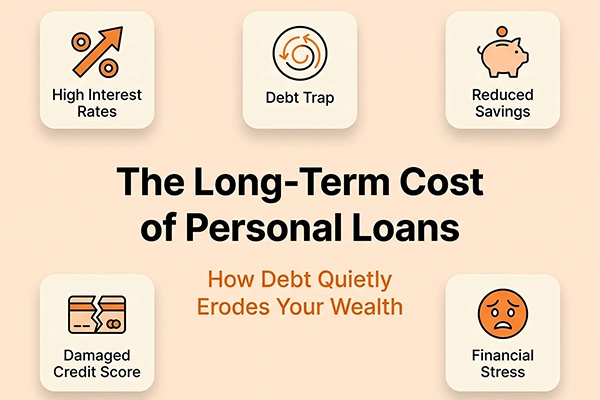
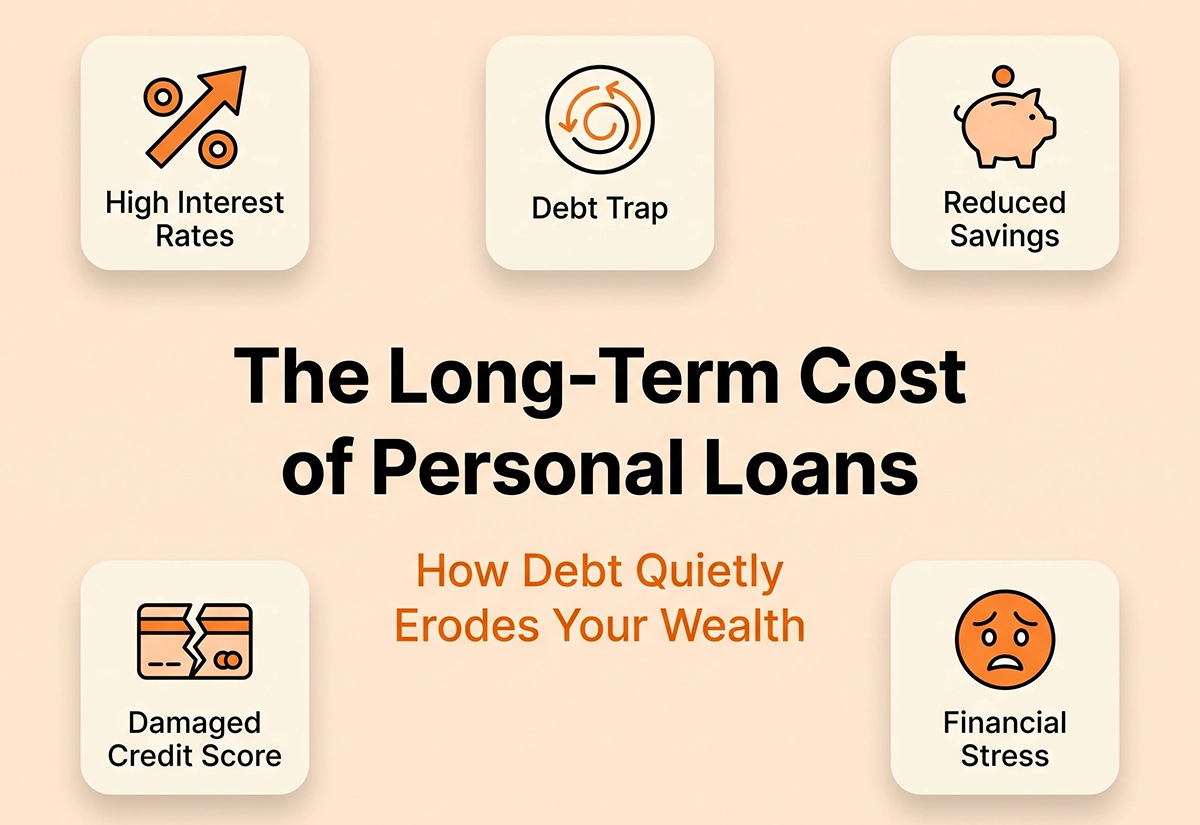
    Here’s a breakdown of the potential consequences of taking a personal loan:

    • High Interest Rates : One of the most significant drawbacks of personal loans is the high interest rates they often carry. These rates can compound quickly, making it difficult to pay off the loan and increasing the overall cost of borrowing.
    • Debt Trap : The high interest rates on personal loans can easily lead to a debt trap. If you are unable to make the monthly payments on time, the interest will continue to accumulate, making it even more difficult to pay off the loan. This can create a vicious cycle of debt that can be challenging to break out of.
    • Reduced Savings : The monthly payments for a personal loan can significantly reduce your disposable income, making it more difficult to save for long-term goals such as retirement, education, or a home. This can have a long-term impact on your wealth accumulation.
    • Damaged Credit Score: Late or missed payments on a personal loan can damage your credit score, making it more difficult to obtain future loans or credit cards. A damaged credit score can also lead to higher interest rates on future loans, further increasing your financial burden.
    • Financial Stress: The burden of debt can lead to financial stress and anxiety, which can negatively impact your overall well-being. This can make it difficult to focus on your financial goals and make sound financial decisions.
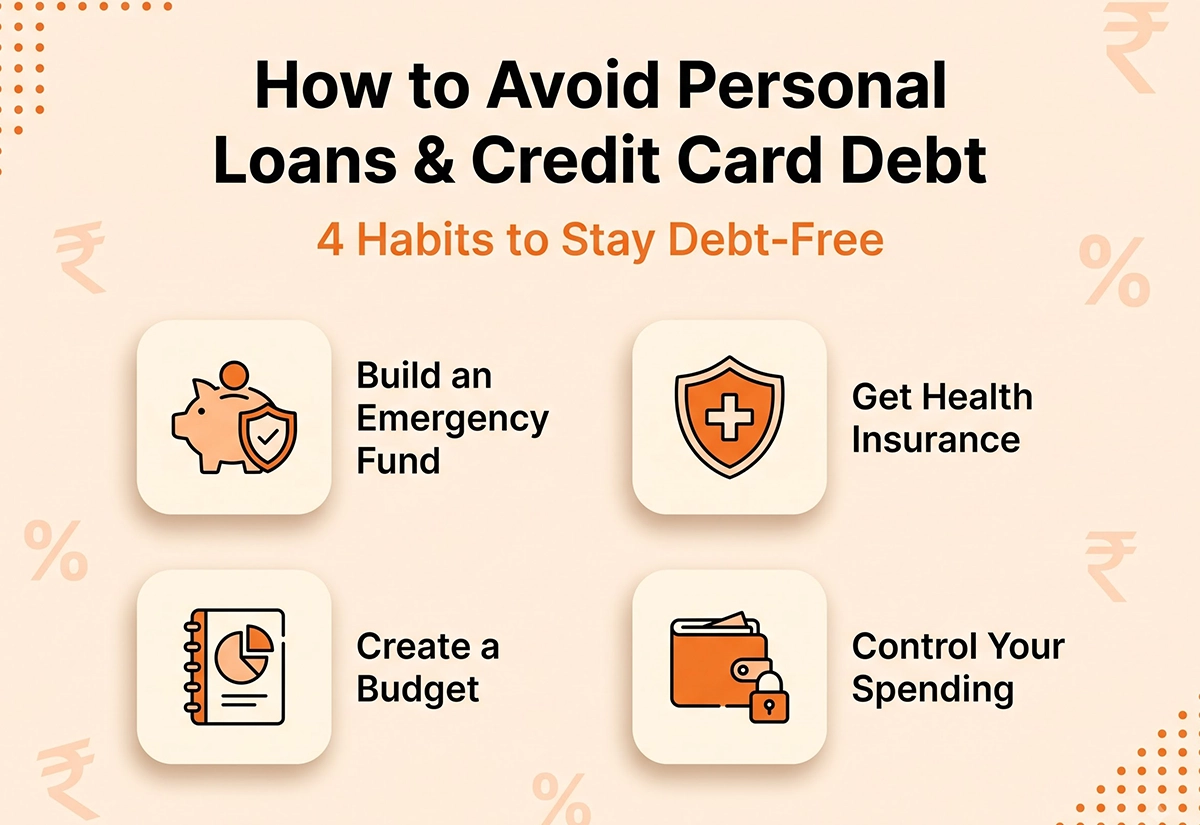
    Piggy bank and savings jar representing a 6-month emergency fund strategy

    How to avoid personal loans and credit card debt:

    Personal loans and credit card debt can significantly impact your financial well-being. Here are effective strategies to avoid them:

    Here are effective strategies to avoid them:

    1. Build an Adequate Emergency Fund:

    • Aim for 6 months’ expenses: A well-funded emergency fund can cover unexpected expenses like medical bills, job loss, appliances break down or car repairs, reducing the need to borrow.
    • Regularly contribute: Set aside a portion of your income each month to build your emergency fund.
    • Invest wisely: Consider investing your emergency fund in a high-yield savings account or a short-term fixed deposits or debt mutual funds for better returns.

    2. Invest in Comprehensive Health Insurance:

    • Protect against medical emergencies: A good health insurance plan can cover a significant portion of your medical expenses, preventing the need to borrow for unexpected medical bills.
    • Choose a plan that suits your needs: Consider factors like coverage limits, deductibles, and co-payments when selecting a health insurance plan.

    3. Create and Stick to a Budget:

    • Track income and expenses: Carefully monitor your income and expenses to identify areas where you can cut back.
    • Prioritize essential expenses: Allocate funds for essential expenses like housing, food, and utilities. You can follow 50:30:20 rule – 50% for essential expenses, 30% for savings and debt repayment& 20% for discretionary expenses.
    • Set financial goals: Define short-term and long-term financial goals to stay focused and motivated.

    4. Control Your Spending:

    • Avoid impulse purchases: Be mindful of your spending habits and avoid unnecessary purchases.
    • Use cash or debit cards: Limit the use of credit cards to avoid accumulating debt.
    • Practice delayed gratification: Give yourself time to think before making a purchase, especially for larger items.

    How to get rid of personal loans and credit card debt:

    If you find yourself in a situation where borrowing is unavoidable, consider these strategies to minimize interest costs and pay off your loan quickly:

    1. Borrow Only What You Need:

    • Assess your financial situation: Carefully evaluate your income, expenses, and existing debt to determine how much you can comfortably afford to borrow.
    • Avoid impulse purchases: Don’t borrow money for unnecessary items or impulsive purchases. Focus on borrowing for essential needs or investments with a clear return on investment.
    • Consider alternative financing options: Explore options like saving up for purchases or negotiating with sellers for better terms before resorting to loans.

    2. Compare Interest Rates:

    • Shop around: Don’t settle for the first loan offer you find. Compare interest rates, fees, and terms from multiple lenders to find the best deal.
    • Consider different loan types: Explore various loan options, such as personal loans, credit card loans, and home loans, to determine which one best suits your needs and financial situation.
    • Check for hidden fees: Be aware of any additional fees or charges associated with the loan, such as processing fees, prepayment penalties, or late payment fees.

    3. Pay Off Debt Quickly:

    • Cut Back on Non-Essential Expenses: Reduce or eliminate expenses like dining out, subscription services, or unnecessary purchases. Explore free or low-cost options for entertainment, hobbies, and other activities. Whenever possible, make additional payments on your loans to reduce the principal amount and interest accrued.
    • Prioritize high-interest debt: Focus on paying off loans with the highest interest rates first to minimize the total cost of borrowing.
    • Consider debt consolidation: If you have multiple debts, consider consolidating them into a single loan with a lower interest rate.

    The Power of Frugal Living: Building Wealth for the Long Term

    For example, let us consider Mr. Ram & his family considered taking a Personal loan of Rs. 10 lakhs for lifestyle upgradation at a 12% interest rate over a 5-year tenure.

    Particulars Details
    Loan Amount: ₹ 10,00,000
    Number of EMIs: 60
    Annual Interest Rate: 12%
    Monthly EMI Payment: ₹ 22,244
    Total Loan Amount Payable: ₹ 13,34,667
    Total Interest Payable: ₹ 3,34,667

    If the family had invested the monthly EMI amount (Rs. 22,244) in an equity mutual fund yielding 10% per year for 5 years and continued to invest the accumulated amount for the next 20 years, they could have potentially built a corpus of approximately Rs. 1.15 crores by the end of 25 years.

    Time frame Monthly Contributions Future value
    1 – 5 Years ₹ 22,244 ₹ 17,03,028
    5 – 10 years Nil ₹ 27,42,744
    10-15 years Nil ₹ 44,17,216
    15 – 20 years Nil ₹ 71,13,971
    20 – 25 years Nil ₹ 1,14,57,121

    Adopting a frugal lifestyle, especially during the early years of your career, can significantly impact your long-term financial health. By being mindful of your spending and prioritizing savings and investments, you can leverage the power of compounding to build substantial wealth over time.

    By following these, you can borrow responsibly and minimize the negative impact of loans on your financial well-being. Remember, responsible borrowing is key to achieving your long-term financial goals.

    Take control of your financial future! Schedule a free consultation with our experienced financial planner today. By understanding the potential risks and benefits of personal and credit card loans, we can help you develop a personalized financial plan that aligns with your long-term goals. Don’t let debt hold you back. Book your consultation now and start building a brighter financial future.

    Calendar Icon Book Your Free Introductory Call

    Recent Blogs

    Best NRI Bank Accounts in India: Complete Guide

    Compare NRE, NRO, FCNR, GIFT City and offshore accounts to understand their tax benefits, repatriation rules and suitability for NRIs.

    Learn More

    How Does Inflation Impact Retirement Planning?

    Learn how inflation impacts retirement savings, income and purchasing power, with strategies to build an inflation-adjusted retirement plan in India.

    Learn More

    3 Ways to Invest Using a Minor Account

    Learn how to invest using a minor account for your child's future, including PPF, SSY and mutual funds, with key benefits and account requirements.

    Learn More

    How Inflation Erodes Wealth and What You Can Do About It

    Learn how inflation erodes wealth, reduces purchasing power, impacts savings and investments, and how to protect your finances from rising costs.

    Learn More

    A Single Parent's Financial Journey From Tragedy to Triumph

    Learn how single parents can manage finances, build an emergency fund, improve insurance coverage, and plan for their child's future.

    Learn More

    Long-Term Impact of Personal Loans on Wealth Creation

    Learn how personal loans and credit card debt affect savings, investments, and long-term wealth creation, with practical ways to manage debt.

    Learn More

    ETFs vs Mutual Funds: Which Is Better?

    Compare ETFs vs mutual funds based on costs, trading, flexibility, pricing, and suitability to choose the right investment option for your goals.

    Learn More

    Estate Planning in India: A Complete Guide

    Learn about estate planning in India, including wills, trusts, powers of attorney, healthcare directives, and beneficiary nominations.

    Learn More

    9 Steps to Save for Your House Down Payment

    Discover 9 practical steps to save for your house down payment, choose suitable investments, manage risk, and build your home-buying fund.

    Learn More

    Child Education Planning: Costs and Investment Strategies

    Understand child education costs, inflation, investment options, SIP planning, and strategies to build a corpus for your child's higher education.

    Learn More

    7 Steps to Choose the Right Investment Products for Your Financial Goals

    Confused about how to choose investment products? Follow these 7 expert-backed steps to align your investments with your financial goals and risk profile.

    Learn More

    Investing During a Market Crash: What the Data Really Shows

    Should you invest during a stock market crash? See historical Sensex data on returns post-crash and learn why panic-selling hurts investors most.

    Learn More

    Dynamic Asset Allocation: What It Is & Why It Works

    What is dynamic asset allocation and how does it work? See how a P/E-based equity-debt strategy outperformed the Sensex by up to 250% since 1999.

    Learn More

    Understanding Wills: Elements, Types & Why They Matter

    What makes a will legally valid in India? Learn its essential elements, types, importance, and what happens to your estate if you die without one.

    Learn More

    Should You Prioritize Insurance Before Investing?

    Confused about whether to buy insurance or start investing first? Learn why risk management through life, health, and disability cover should come before investments.

    Learn More

    Are Index Funds the Right Choice for You?

    Wondering if index funds are right for you? Learn why chasing top-performing mutual funds fails and how index funds simplify long-term investing.

    Learn More

    Goals Based Investing vs Market Volatility: A Complete Guide

    How does a goals based investment approach help during market volatility? Learn why linking investments to your goals beats reacting to market swings.

    Learn More

    The Right Way to Calculate Your Life Insurance

    How much life insurance do you really need? Learn the Income Replacement and Need Based methods to calculate the right cover for your family.

    Learn More

    REITs Explained: Types, Taxation & How to Invest

    What are REITs and how do you invest in them in India? Learn types, tax rules, pros and cons before adding real estate exposure to your portfolio.

    Learn More

    Right Time to Buy Your Dream House: A Complete Guide

    When is the right time to buy your dream house in India? Explore 4 key factors — economic conditions, interest rates, market trends, and finances.

    Learn More

    The Right Time to Invest During a Market Correction

    We are all shaken, shaken by the ferocity of the fall in the stock markets. Never have we seen a correction of this magnitude in such a short period.

    Learn More

    Why Stock Markets Will Remain Volatile?

    The reason why stock markets fluctuate revolves around the theory of demand and supply. If more people want to buy a stock, its market price will increase.

    Learn More

    What Is a Super Top-Up Health Insurance Policy and How Does It Work?

    Base Policy and Super Top Up Policy are two commonly used options while taking Health Insurance. Health insurance is an important tool to safeguard your financial well-being against unexpected medical expenses. As medical treatments become more expensive

    Learn More

    Limited Pay vs Regular Pay — Which Life Insurance Premium Option Is Right for You?

    Limited pay vs regular pay – it is easy to get confused between options for your life insurance premium payment. While Life insurance plays a crucial role in securing the financial future of your loved ones.

    Learn More

    What Should You Do With Your Life Insurance Policy?

    In Indian families, pressure to buy traditional life insurance policies can be strong and multifaceted. Parents often play the “security card,” emphasizing the importance of safeguarding their child’s future and highlighting potential future burdens or painting a picture of an uncertain future without the policy.

    Learn More

    Comprehensive Guide on Home Loan Overdraft Facility

    Imagine a financial tool that combines the stability of a home loan with the flexibility of an overdraft account – that’s precisely what the Home Loan Overdraft Facility entails.

    Learn More

    How to Choose from Different Gold Investment Options

    Confused about gold investment options in India? From physical gold to SGBs, this guide compares costs, tax rules, and returns to help you make the right choice.

    Learn More

    Index Funds - Advantages, Risks & Suitability

    Index Funds are an investment instruments that are based on stock market indices like Sensex or Nifty. These funds are built using a pre-set basket of stocks from different sectors of the economy with predefined weights.

    Learn More

    Direct Funds vs Regular Funds - Are Direct Mutual Funds better ?

    Confused between direct and regular mutual funds? Compare expense ratios, NAV, and returns to find out which plan helps you grow your wealth long-term.

    Learn More

    SSY Interest Rates, Tax Benefits, & Withdrawal Rules

    Sukanya Samriddhi Yojana (SSY) is an initiative launched by the Government of India as part of its Beti Bachao, Beti Padhao campaign, (Save the Girl Child, Educate the Girl Child).

    Learn More

    7 Types of Financial Ratios to Assess your personal finance & ways to improve them

    Understanding the 7 types of financial ratios is a vital exercise that individuals should undertake to assess the state of their financial well-being.

    Learn More

    What Should you do with your 401K Account if you Move Back to India

    Moving back to your home country after years of working in the US is an exciting chapter. However, it also comes with its own set of financial considerations, especially when it comes to your US retirement savings.

    Learn More

    What Are ULIP Charges and How Do They Work

    Know about ULIP charges in India covering mortality, policy admin, switching, surrender, and guarantee fees to help you decide if ULIP is worth investing in.

    Learn More

    Key Features of NPS (National Pension Scheme)

    The National Pension Scheme is a government-sponsored retirement savings plan introduced in India in 2004. It provides a structured approach for individuals to build a retirement fund by making regular contributions.

    Learn More

    ESOPs vs RSUs vs ESPPs - Understand the 7 key differences

    In today's competitive Indian job market, companies are increasingly turning to equity compensation plans to attract and retain top talent.

    Learn More

    12 Risks of Investing ESOPs/RSUs/ESPPs

    Imagine your future self, financially secure thanks to a hefty chunk of your employer's stock, a reward for your dedication and hard work.

    Learn More

    What Should You Do With Your Life Insurance Policy Decision

    Confused about what should you do with your life insurance policy? In Indian families, pressure to buy traditional life insurance policies can be strong and multifaceted.

    Learn More

    5 Proven Ways to Build Stable Post Retirement Income in India

    Retirement brings major changes in income and life. Investments and savings can help you meet your needs, but a steady income is still essential for daily expenses and regular cash flow.

    Learn More

    12 Must Follow Financial Practices Before Moving Abroad

    When one is leaving the familiar shores of India for a new life abroad, it may be both exciting and daunting. It's exciting to pack up your bags and head out on a new adventure, but one of the biggest challenges you will face is getting used to a new financial environment.

    Learn More

    5 Reasons to Prefer a Fee-Only Financial Planner in India

    The term "financial planner" is used often and very loosely. In India, many people call themselves financial planners, the insurance agent, the mutual fund distributor,

    Learn More

    How do Financial Planners & Advisors Get Paid in India?

    SEBI (Securities Exchange Board of India), with its latest amendments to Registered Investment Adviser (RIA) Regulations, mandates that all registered financial planners can charge only on two bases. A Financial Planner can either charge a fee for financial planning or earn from distribution of financial products.

    Learn More

    How to Choose The Best Financial Advisor In India

    If you are confused about how to choose the best financial advisor in India, you can thank the Securities Exchange Board of India (SEBI).

    Learn More

    6 Reasons to Review Your Financial Plan for Better Financial Health

    Reviewing your financial plan matters as much as using a trusted navigation system. When you move forward without regular reviews, you risk heading in the wrong direction.

    Learn More

    SEBI's mandatory disclosure requirement

    View More
    WhatsApp
    Phone Call