Goals Based Investing vs Market Volatility: A Complete Guide

Table of Contents

    Importance of Risk Profiling in Goal-Based Investing
    We all know that driving a car without knowing the destination will land you nowhere. Similarly, investing without clearly defining your goals/objectives will not give you the desired results.

    A Goals Based Investment Approach is process of allocating money to achieve a predefined objective. It could be saving for a vacation, buying your car, building your dream house or accumulating a corpus for retirement. Clearly knowing what you want helps to identify and focus on factors that can affect the goals.


    Goals Based Approach for Child’s Graduation

    For instance, if your goal is to accumulate for your child’s graduation, a goal based approach will force you to answer the below questions;

    How many years do you have?

    You will be able to tolerate high fluctuations and invest in higher return generating assets like equities if you know that you have more than 5 to 7 years for your goals.

    Importance of risk profiling

    A goals based investment approach will help you understand the importance of risk profiling and will assess three important parameters; your capacity to take risk, willingness to take risk and need to take risk. A holistic understanding of these parameters will help you arrive at the right asset allocation for your investments.

    Destination of Study

    Where would you like you child to study? If there are no good colleges in your city, you will have to budget for hostel and living expenses.

    Impact of Inflation on Education

    Education inflation in India has been quite high compared to the general inflation. You will be able to consider the right inflation number for this goal and ensure that you don’t fall short.

    Goals Based Investment Approach v/s Market Situations Linked

    The current market volatility has put considerable emotional strain on investors. When the market tanked by 35% in March 2020, a lot of investors panicked and liquidated their investments. They are now regretting seeing a close to 50% upside from the March lows. Most investors fail to understand that timing the markets are very difficult and a futile exercise. We have seen that markets rebound eventually and make up for the temporary losses. In fact, it is the nature of the market to be volatile and timely market corrections are considered as a healthy event. Read here to understand what happens if you invest during a stock market correction.

    A Goals Based Investment Approach helps you overcome these temporary events and take advantage of market corrections. When you know that the market always recover and your goals are still far away, you would be tempted to invest more at favorable prices and valuations instead of panicking and selling out. Systematic investments done during these times help you increase the returns on your portfolio over the long run and will definitely reduce anxiety.

    Goals Based Investment Approach will clearly define the intervals and trigger for re-balancing and need to take action on your portfolio. With your financial planner defining your risk profile and ideal asset allocation, you know exactly what percentage of investments should be held in equity, debt, real estate etc. It is common for this to vary as time passes. A good plan defines the deviation at which you will need to take action and re-balance your portfolio.

    Equities are a great tool to build wealth in the long term. They have certainly helped individuals achieve their goals. While they are predictable in the long run (more than 7 years), they are extremely volatile in the short run. This is precisely why it is important to change your allocations as you approach near your goal due date. A goals based investment approach will illustrate how you can reduce exposure to equities and ensure adequate liquidity when you goal is due.

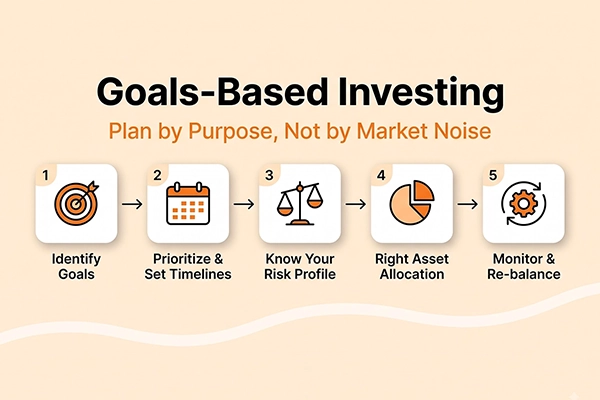
    Steps In Goals Based Investment Approach

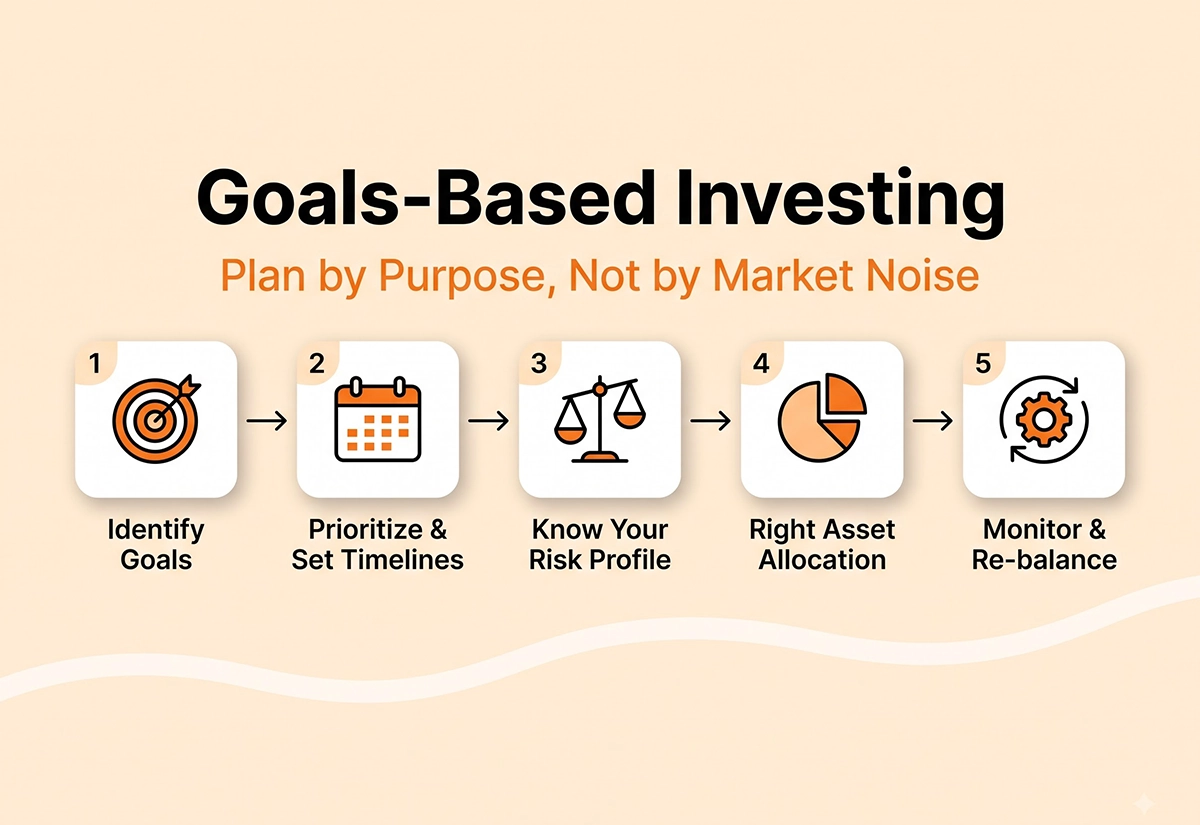
    • Identify your goals.
    • Prioritize your goals and know when they are due.
    • Understand your risk profile or reach out to a financial planner if you are not clear.
    • Formulate the right asset allocation matrix based on your risk profile.
    • Study and choose the right investment instruments in each asset class. For instance, in equities you will the below options;
    • Direct equity via stocks/share on the stock market – You need the right skill sets to identify the right stocks and track them, increase or reduce the allocation to each stock based on performance and future potential.
    • Mutual Funds – You have the option to invest in different types – Large Cap, Multi-cap, Mid Cap, Small Cap and many others. The advantage of a mutual fund is professional management. You get a fund manager and his team to track the different stocks and invest on your behalf.
    • Set monitoring frequency and triggers for re-balancing your portfolio. This is just like regular de-weeding of your garden. Without this, you will lose track of your investments and your portfolio will start to under perform.

    Connect with a SEBI Registered Fee Only Financial Planner to help you with your goals. Book a Free Consultation Call today.

    Calendar Icon Book Your Free Introductory Call

    Recent Blogs

    7 Steps to Choose the Right Investment Products for Your Financial Goals

    Confused about how to choose investment products? Follow these 7 expert-backed steps to align your investments with your financial goals and risk profile.

    Learn More

    Investing During a Market Crash: What the Data Really Shows

    Should you invest during a stock market crash? See historical Sensex data on returns post-crash and learn why panic-selling hurts investors most.

    Learn More

    Dynamic Asset Allocation: What It Is & Why It Works

    What is dynamic asset allocation and how does it work? See how a P/E-based equity-debt strategy outperformed the Sensex by up to 250% since 1999.

    Learn More

    Understanding Wills: Elements, Types & Why They Matter

    What makes a will legally valid in India? Learn its essential elements, types, importance, and what happens to your estate if you die without one.

    Learn More

    Should You Prioritize Insurance Before Investing?

    Confused about whether to buy insurance or start investing first? Learn why risk management through life, health, and disability cover should come before investments.

    Learn More

    Are Index Funds the Right Choice for You?

    Wondering if index funds are right for you? Learn why chasing top-performing mutual funds fails and how index funds simplify long-term investing.

    Learn More

    Goals Based Investing vs Market Volatility: A Complete Guide

    How does a goals based investment approach help during market volatility? Learn why linking investments to your goals beats reacting to market swings.

    Learn More

    The Right Way to Calculate Your Life Insurance

    How much life insurance do you really need? Learn the Income Replacement and Need Based methods to calculate the right cover for your family.

    Learn More

    REITs Explained: Types, Taxation & How to Invest

    What are REITs and how do you invest in them in India? Learn types, tax rules, pros and cons before adding real estate exposure to your portfolio.

    Learn More

    Right Time to Buy Your Dream House: A Complete Guide

    When is the right time to buy your dream house in India? Explore 4 key factors — economic conditions, interest rates, market trends, and finances.

    Learn More

    The Right Time to Invest During a Market Correction

    We are all shaken, shaken by the ferocity of the fall in the stock markets. Never have we seen a correction of this magnitude in such a short period.


    Learn More

    Why Stock Markets Will Remain Volatile?

    The reason why stock markets fluctuate revolves around the theory of demand and supply. If more people want to buy a stock, its market price will increase.

    Learn More

    What Is a Super Top-Up Health Insurance Policy and How Does It Work?

    Base Policy and Super Top Up Policy are two commonly used options while taking Health Insurance. Health insurance is an important tool to safeguard your financial well-being against unexpected medical expenses. As medical treatments become more expensive

    Learn More

    Limited Pay vs Regular Pay — Which Life Insurance Premium Option Is Right for You?

    Limited pay vs regular pay – it is easy to get confused between options for your life insurance premium payment. While Life insurance plays a crucial role in securing the financial future of your loved ones.

    Learn More

    What Should You Do With Your Life Insurance Policy?

    In Indian families, pressure to buy traditional life insurance policies can be strong and multifaceted. Parents often play the “security card,” emphasizing the importance of safeguarding their child’s future and highlighting potential future burdens or painting a picture of an uncertain future without the policy.

    Learn More

    Comprehensive Guide on Home Loan Overdraft Facility

    Imagine a financial tool that combines the stability of a home loan with the flexibility of an overdraft account – that’s precisely what the Home Loan Overdraft Facility entails.

    Learn More

    How to Choose from Different Gold Investment Options

    Confused about gold investment options in India? From physical gold to SGBs, this guide compares costs, tax rules, and returns to help you make the right choice.

    Learn More

    Index Funds - Advantages, Risks & Suitability

    Index Funds are an investment instruments that are based on stock market indices like Sensex or Nifty. These funds are built using a pre-set basket of stocks from different sectors of the economy with predefined weights.

    Learn More

    Direct Funds vs Regular Funds - Are Direct Mutual Funds better ?

    Confused between direct and regular mutual funds? Compare expense ratios, NAV, and returns to find out which plan helps you grow your wealth long-term.

    Learn More

    SSY Interest Rates, Tax Benefits, & Withdrawal Rules

    Sukanya Samriddhi Yojana (SSY) is an initiative launched by the Government of India as part of its Beti Bachao, Beti Padhao campaign, (Save the Girl Child, Educate the Girl Child).

    Learn More

    7 Types of Financial Ratios to Assess your personal finance & ways to improve them

    Understanding the 7 types of financial ratios is a vital exercise that individuals should undertake to assess the state of their financial well-being.

    Learn More

    What Should you do with your 401K Account if you Move Back to India

    Moving back to your home country after years of working in the US is an exciting chapter. However, it also comes with its own set of financial considerations, especially when it comes to your US retirement savings.

    Learn More

    What Are ULIP Charges and How Do They Work

    Know about ULIP charges in India covering mortality, policy admin, switching, surrender, and guarantee fees to help you decide if ULIP is worth investing in.

    Learn More

    Key Features of NPS (National Pension Scheme)

    The National Pension Scheme is a government-sponsored retirement savings plan introduced in India in 2004. It provides a structured approach for individuals to build a retirement fund by making regular contributions.

    Learn More

    ESOPs vs RSUs vs ESPPs - Understand the 7 key differences

    In today's competitive Indian job market, companies are increasingly turning to equity compensation plans to attract and retain top talent.

    Learn More

    12 Risks of Investing ESOPs/RSUs/ESPPs

    Imagine your future self, financially secure thanks to a hefty chunk of your employer's stock, a reward for your dedication and hard work.

    Learn More

    What Should You Do With Your Life Insurance Policy Decision

    Confused about what should you do with your life insurance policy? In Indian families, pressure to buy traditional life insurance policies can be strong and multifaceted.

    Learn More

    5 Proven Ways to Build Stable Post Retirement Income in India

    Retirement brings major changes in income and life. Investments and savings can help you meet your needs, but a steady income is still essential for daily expenses and regular cash flow.

    Learn More

    12 Must Follow Financial Practices Before Moving Abroad

    When one is leaving the familiar shores of India for a new life abroad, it may be both exciting and daunting. It's exciting to pack up your bags and head out on a new adventure, but one of the biggest challenges you will face is getting used to a new financial environment.

    Learn More

    5 Reasons to Prefer a Fee-Only Financial Planner in India

    The term "financial planner" is used often and very loosely. In India, many people call themselves financial planners, the insurance agent, the mutual fund distributor,

    Learn More

    How do Financial Planners & Advisors Get Paid in India?

    SEBI (Securities Exchange Board of India), with its latest amendments to Registered Investment Adviser (RIA) Regulations, mandates that all registered financial planners can charge only on two bases. A Financial Planner can either charge a fee for financial planning or earn from distribution of financial products.

    Learn More

    How to Choose The Best Financial Advisor In India

    If you are confused about how to choose the best financial advisor in India, you can thank the Securities Exchange Board of India (SEBI).

    Learn More

    6 Reasons to Review Your Financial Plan for Better Financial Health

    Reviewing your financial plan matters as much as using a trusted navigation system. When you move forward without regular reviews, you risk heading in the wrong direction.

    Learn More

    SEBI's mandatory disclosure requirement

    View More
    WhatsApp
    Phone Call