In today's dynamic financial landscape, mutual funds have become a popular investment option in India. Whether you're a seasoned investor or just starting, the sheer number of options and the constant market fluctuations can feel daunting.
These professionally managed funds pool money from numerous investors, offering a convenient and accessible way to participate in India's growing capital markets. They provide diversification across various asset classes like stocks, bonds, and other securities.


They provide advantages such as professional expertise, potential for higher returns, and the ability to invest even small amounts. This makes them suitable for investors with varying risk tolerances and financial goals. As the Indian economy continues to develop, mutual funds will play an increasingly significant role in the financial landscape.

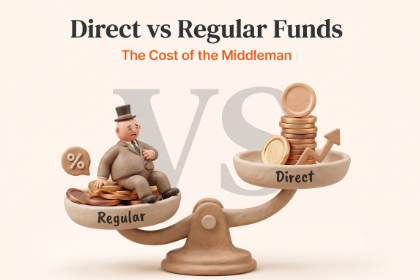
Let us explore the 2 primary types of mutual funds in India, regular mutual funds and direct mutual funds, and understand the differences between them.
In this type of mutual fund, the investor invests in the fund through a broker, distributor, or any other intermediary.
The fund house pays a commission to that intermediary and gets added to the fund's expense ratio. Because of this, regular plans have a higher expense ratio than direct plans. This higher cost reduces overall returns over time.
If you invest around Rs. 10 Lakhs in a regular mutual fund. The plan has about the 1% extra cost. This means RS 10,000 goes every year as commission. This cost reduces returns over time.
In this type of mutual fund, you invest directly through the Asset Management Company (AMC) that manages the fund.
There's no broker or advisor involved. The fund does not pay any commissions, so the expense ratio remains lower. Because of this, investors can earn slightly better returns over time.
If you invest Rs. 10 Lakhs in a direct fund, you need not pay any commission. The amount stays invested. Over time, this helps the investment grow better.
| Factor | Regular Mutual Funds | Direct Mutual Funds |
|---|---|---|
| Expense Ratio | Higher cost due to distributor commission added | Lower cost as no commission is involved |
| Returns | Returns stay lower due to higher ongoing costs | Returns improve slightly due to lower overall cost |
| Commission | Pays commission to broker or fund distributor | No commission paid to any intermediary involved |
| Advice Bias | Advice may favor funds with higher commission payouts | No bias as no third party is involved |
| Control & Transparency | Less control, and cost details are not fully clear | More control with clear and transparent cost details |
Understanding the tax implications and exit loads when exiting regular mutual funds and reinvesting in direct mutual funds:
When an investor sells regular mutual fund units, the profit counts as capital gains. This gain is taxable in India.
The tax depends on the type of fund and how long the investment stays invested.
For equity mutual funds:
Holding the investment for more than 1 year usually helps reduce tax.
Debt mutual funds bought before 31 March 2023 and held for more than 3 years can use indexation.
Indexation adjusts the purchase price for inflation. This lowers the taxable gain and reduces tax.
From 1 April 2023, indexation no longer applies to most plain debt funds. It still applies only to certain hybrid funds with equity between 35% and 65%, as per current tax rules.
Some mutual funds charge an exit load if units are sold early.
This is a small fee, usually 0.5% to 1%, that applies when an investor redeems units before a set period, often 1 year.
The exit load reduces the final amount received. The rule applies to both regular and direct plans of the same scheme.
When switching from regular to direct mutual funds, the process happens in two steps:
First step : You redeem units from the regular mutual fund. Capital gains tax applies on any profit, and exit load gets deducted if it is applicable.
Second step : You invest the redeemed amount into a direct mutual fund. No new tax applies at the time of investment. The new investment starts with a fresh purchase value, and future gains get taxed only when you sell the units later.
Before switching from regular mutual funds to direct mutual funds, speak with a leading financial advisor or tax consultant. At Wealth Crafts, a trusted SEBI Registered Investment Advisor in Bangalore ,we help you understand the tax impact based on your personal situation with clear and simple advice.
Also, review your investment goals, risk level, and investment time frame before making any changes to your portfolio. These factors help you choose the right option for your needs.
Understanding the difference between regular and direct mutual funds plays an important role in long-term investing.
Always compare the cost difference and tax rules before you decide. With the right guidance from Wealth Crafts, you can make a more informed and steady investment choice.