Direct Funds vs Regular Funds: Key Differences Every Investor Must Know
What Are Direct Mutual Funds & How Do They Work?

Image description
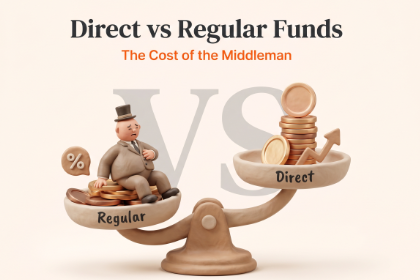
Title: Direct vs Regular Funds. Subtitle: The Cost of the Middleman. A balance scale with a large VS behind it. The left pan, labeled Regular, sits lower and holds a seated figure in a suit and top hat on a pile of coins, with a percent sign speech bubble beside it, representing the middleman's cost. The right pan, labeled Direct, sits higher and holds a tall stack of coins with an upward-trending arrow, suggesting that direct plans let more of the investor's money grow.
Before we get into Direct Funds vs Regular Funds lets understand about mutual funds. Mutual funds offer investors easy access, liquidity, and straightforward exits, while also transferring investment management risk to professional fund managers. A mutual fund serves as a collective investment vehicle, pooling funds from multiple investors to invest in equities, bonds, government securities, and money market instruments.
Professional fund managers oversee the investment of these pooled funds according to the scheme's objectives and the generated income or gains are distributed proportionally among investors.
Direct Funds vs Regular Funds: Understanding the Key Differences
Confused about direct funds vs regular funds? These investment options have been generating a lot of buzz, but many people are unclear on the key distinctions and which one best suit their needs. This guide will break down the difference between regular and direct plans, focusing on their cost structure and investment process.
Direct mutual funds take the middleman out of the equation. You invest directly with the Asset Management Company (AMC) that runs the fund. Think of it like buying clothes directly from the brand instead of a department store. By cutting out the middleman, AMCs can offer you a lower Total Expense Ratio (TER). TER is basically the annual fee you pay to own the fund, and a lower TER means more of your hard-earned cash gets invested and potentially grows over time.
So, how do you invest directly? It is easy! You can do it through the AMC's website, visit their office, or even work with a SEBI Registered Investment Advisor (RIA) who specializes in direct plans.
Direct mutual funds offer a cost-effective way to invest. Lower fees mean more potential returns for you in the long run. Now that you know the benefits, are you ready to ditch the middleman and take control of your investments?
Regular mutual funds on the other hand are invested through distributors who agents of the mutual fund companies. Sounds helpful, right? There is a catch! Distributors get paid commissions by the AMC (Asset Management Company) for as long as you stay invested. These commissions are added to the fund's TER (Total Expense Ratio), making regular plans more expensive than direct plans. So, the convenience of a guided approach comes at a price.
Key Differences - Direct Funds vs Regular Funds
Net Asset Value
Total Expense Ratio (TER) : Think of TER as the management fee of a mutual fund. It covers things like salaries and operational costs. Lower TER means more of your money goes towards actual investments.
Direct Funds vs Regular Funds : Regular funds involve distributors who offer guidance but charge commissions. These commissions get added to the TER, making them more expensive than direct plans where you invest directly with the fund company.
A lower TER in direct plans translates to a higher Net Asset Value (NAV). NAV represents the price per unit of the fund. So, with a direct plan, you get more units for your money, potentially leading to higher returns in the long run.
Returns
Direct funds yield superior long-term returns attributed to their lower expense ratios. In contrast, regular plans encompass commissions, leading to higher Total Expense Ratios (TERs) and diminished returns. Discrepancies in TERs typically span from 0.5% to 1%, significantly impacting returns. Over an extended duration, opting for a direct plan can culminate in a notable disparity in investment returns.
Expense Ratio
Expense ratio in mutual funds is like a fee you pay for someone to manage your money. It includes all the costs of running the fund, like salaries, office expenses, and other fees. It's shown as a percentage of your investment, so if you invest ₹100 and the expense ratio is 1%, you pay ₹1 every year.
Direct Funds vs Regular Funds - Understanding difference in expense ratio with example
Let's say you invest Rs. 10,000 in a mutual fund with an expense ratio of 1%. This translates to a daily fee of (1%/365) = 0.0027% (approximately).
This fee isn't deducted as a lump sum at the beginning. Instead, a tiny portion is taken out each day you are invested. While it might seem insignificant, it adds up over time.
Imagine you forget a few pennies lying around every day. Over a year, those forgotten pennies could add up to a surprising amount!
The good news? Mutual funds with lower expense ratios take a smaller bite out of your returns. This means more of your money stays invested and has the potential to grow through compounding interest.
Regular plans generally entail higher expense ratios relative to direct plans, whereas direct plans afford greater returns and enhanced investment convenience.
Intermediary
With direct mutual funds, you invest directly with the Asset Management Company (AMC) that runs the fund. There is no broker or distributor involved, so you save on commission fees.
Regular mutual funds, on the other hand, involve intermediaries like brokers who offer guidance but charge commissions for their service. These commissions are added to the overall cost of the fund.
How To Recognize If a Mutual Fund is Direct Funds vs Regular Fund?
Distinguishing between direct funds vs regular funds can be confusing for many investors, potentially leading to the selection of an inappropriate option. To navigate this confusion, here are several key indicators that can aid in identifying whether a fund is direct fund vs regular fund
- Regular funds typically include the term "Regular" or "Reg" in the name of the mutual fund scheme. Conversely, direct funds feature "Direct" or "Dir" attached to the scheme's name.
- Another indicator to consider is the Net Asset Value (NAV) of the fund. In most cases, direct plans tend to have a higher NAV when compared to regular plans.
- You can also assess the expense ratio of both types of plans. Typically, regular plans tend to have a higher expense ratio compared to direct plans.
Maximize Your Returns: A Guide to Switching from Regular to Direct Mutual Fund Plans
How to Switch from Regular to Direct Fund?
Online Mode:
- Find Your Account : Log in to your online mutual fund account. This might be through the AMC's website directly or via platforms like CAMS or KFintech.
- Navigate to Transactions : Locate the section for buying, selling, or switching your fund units. It is often called the "Transactions" or "Investment" page.
- Initiate the Switch : Look for a "Switch" option and select the specific fund you want to convert.
- Go Direct! : You should see a "Direct Plan" option. Click on that and follow the on-screen instructions to complete the switch.
It can take about three to four business days for the change to reflect in your account.
Offline Mode:
- Visit the Fund House : Head to the nearest branch of the Asset Management Company (AMC) that runs your mutual fund.
- Fill Out the Switch Form : Ask for a "switch form" and fill it out carefully. It will ask for details like your folio number and the fund name you want to convert to (make sure you choose the "Direct Plan" option).
- Submit and Wait : Hand over the completed form to a representative at the branch. The processing typically takes a few business days, and you will receive an updated account statement reflecting the change.
Intermediary Option : If you prefer, you can also get help with the switch process through your existing broker or financial advisor.
Why Switch from Regular to Direct Plan?
Before 2013, buying mutual funds meant going through advisors, banks, or distributors. But the Securities and Exchange Board of India (SEBI) changed the game with Direct Plans. This lets you invest directly with the fund house, cutting out the middleman and their commissions.
Regular Funds : You pay a commission to brokers or distributors who help you choose funds. This commission gets added to the fund's expense ratio, making it more expensive.
Direct Funds : You invest directly, so there is no commission and the expense ratio are lower. This translates to potentially higher returns in the long run.
Direct Funds are ideal for:
- Savvy Investors : You are comfortable researching and choosing funds yourself.
- Investment Advisors : SEBI Registered Investment Advisors are mandated to recommend only Direct Funds.
- Cost-Conscious Investors : You want to keep investment fees as low as possible.
However, some people prefer regular plans for the convenience of getting advice.
Direct plans empower you to take control and potentially boost your returns, but require more initiative on your part.
How will it Impacts the returns?
Let us understand with an example.
Akash and Vignesh invested in the same mutual fund (Nippon India Large Cap Fund) on the same day (i.e. 21st January 2013), but choose different plans.
| Particulars | NAV as on 21st January 2013 | Units on invested value of ₹ 1 lakh as on 21st Jan 2013 | NAV as on 29th May 2024 | Mutual Fund Value as on 29th May 2024 |
|---|---|---|---|---|
| Nippon India Large Cap Fund Direct Plan | 14.93 | 6698 | 89.65 | ₹ 6,00,469 |
| Nippon India Large Cap Fund Regular Plan | 14.91 | 6707 | 81.17 | ₹ 5,44,400 |
The above mutual fund has been used only for illustration purpose and should not construed as investment advice.
Akash invests ₹ 1 lakh in the Direct Growth Plan of a mutual fund. The net asset value (NAV) as on 21st January 2013 is ₹ 14.93 per unit, and this investment will get him approximately 6,698 units in the mutual fund.
Vignesh invests ₹ 1 lakh in the Regular Plan of mutual fund. The net asset value (NAV) as on 21st January 2013 is ₹ 14.91 per unit, and this investment will get him approximately 6,707 units in this mutual fund.
Fast forward to May 29, 2024:
- The NAV of the Direct Growth Plan (Akash's plan) has grown to ₹ 89.65 (Having an expense ratio of 0.74%). The value of Akash's investment is now ₹ 600,475.70 (a gain of ₹ 500,474.56).
- The NAV of the Regular Plan (Vignesh's plan) has grown to ₹ 81.17 (Having an expense ratio of 1.61%). The value of Vignesh's investment is now ₹ 5,44,407 (a gain of ₹ 4,44,405).
Even though Akash and Vignesh started with similar investments, Akash's choice of a direct plan having a lower expense ratio plan resulted in a significant difference in their final returns (over ₹ 56,000).
This example highlights the impact of expense ratios on mutual fund returns. By choosing a lower expense ratio plan, investors can potentially earn more money over time.
Disclaimer : It is important to note that the mentioned fund is not an investment advice, and you should always conduct your own research or contact a financial advisor before making any investment decisions.
Conclusion
While regular mutual funds offer the convenience of guidance from advisors, there is a price to pay for that service. The commissions translate to higher fees that can eat into your potential returns over time.
If you are comfortable doing your own research and want to maximize your investment growth, then switching to direct mutual funds is a compelling option. The lower expense ratios can lead to a significant difference in your returns, especially over the long term.
Think of it as putting more money to work for you! Direct plans empower you to take charge of your investments and potentially watch your wealth grow at a faster pace.
Are you ready to take charge of your financial future? It is time to rethink your investment strategy and consider exiting regular mutual funds. As a savvy investor, you deserve more control and transparency over your portfolio. Regular mutual funds often come with hidden fees, mediocre performance, and limited flexibility. But by making the switch, you can unlock a world of opportunities for greater returns and tailored investment solutions. Do not let your hard-earned money sit idly in underperforming funds any longer. Take the first step towards financial empowerment today and Schedule a free consultation call today to explore alternative investment options that align with your goals and priorities.