Are Index Funds the Right Choice for You?

Table of Contents

    What Are Index Funds and How Do They Work?
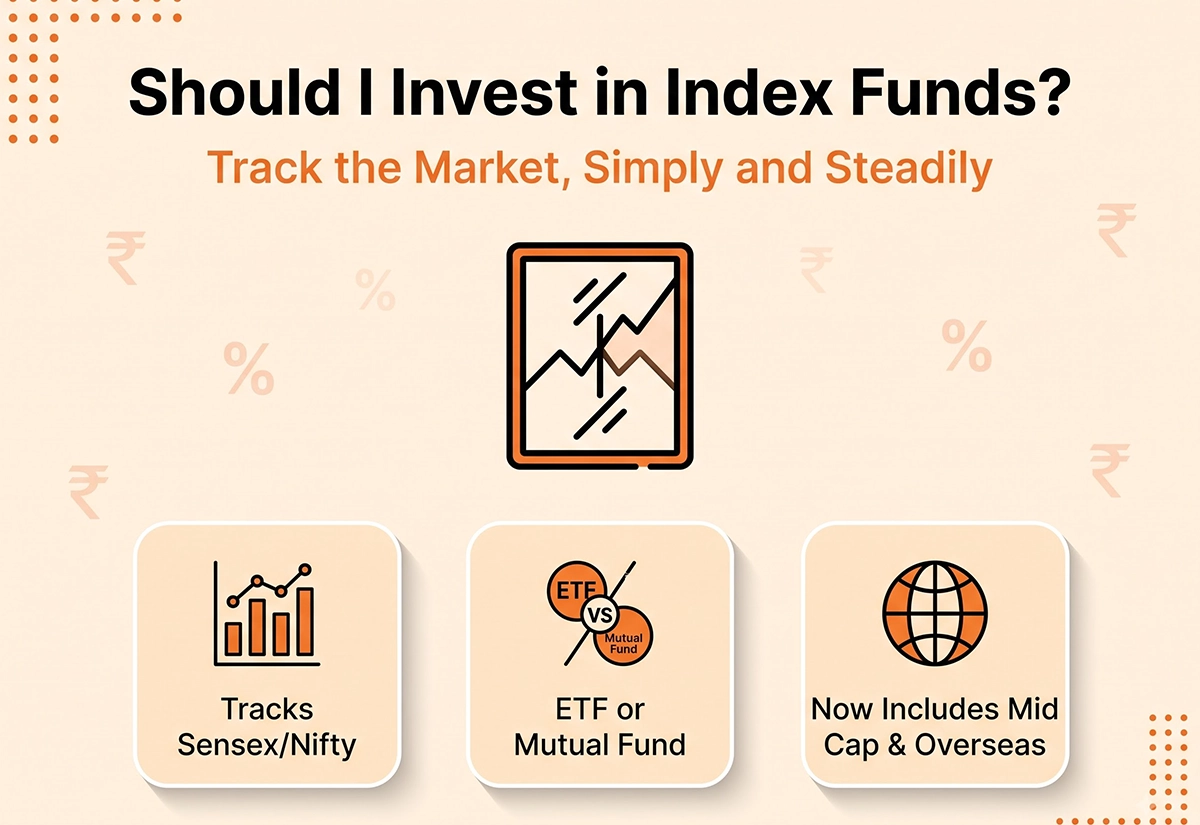
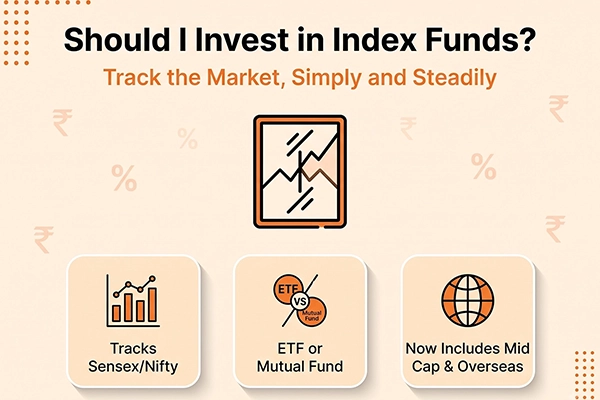
    Index Funds are an investment instruments that are based on stock market indices like Sensex or Nifty. These indices are built on the basis of the free-float market capitalization of biggest companies in India. The purpose of an Index Fund is to imitate the exact portfolio of the index that it is tracking, i.e., a Sensex Index Fund will hold all the 30 companies that comprise the Sensex in the exact same proportion of weights they have in Sensex.

    Index Funds could be in the form of an ETF (Exchange Traded Fund) or in the form of a Mutual Fund. Each have their own advantages and disadvantages, you can read more about them here. In India, majority of the Index funds primarily focus on the front line indexes like Nifty, Nifty Next50, SENSEX, etc. which are also bench-marked by large cap mutual funds. Of lately, investors now have wider options to invest in Index Funds that track the Mid Cap Indices and Overseas Indices.


    Yearly Performance of Actively Managed Large Cap Funds
    Why you should Stop Chasing Best Funds

    The above table illustrates heat map of the yearly returns for the most popular large cap mutual funds in India. It is evident that no single mutual fund stays in the top year after year and chasing the best large cap mutual funds or jumping from one best fund to the other could cause you more harm. Let take an example, let’s say you wanted to invest ₹ 1,00,000/- in 2013, you look at the previous year’s returns and select the fund with the best performance, and you would end up investing in Nippon Large Cap Fund.

    No Consistency in Performance

    But by the end of the year you end up being disappointed, your dream fund which gave the best returns was among the bottom performers. So you jump to the best large cap mutual funds of 2013; which was Axis Blue Chip Fund, in early 2014 and stay invested. If you did that, your returns would have been lower as of end 2019 by ₹ 23,000/- even after out performance for two consecutive years from Axis in 2018 and 2019. Not to mention about the costs incurred in the form of taxes or exit loads. And this happens across different time horizons across different fund types.

    Difficult to Predict the next Best Fund

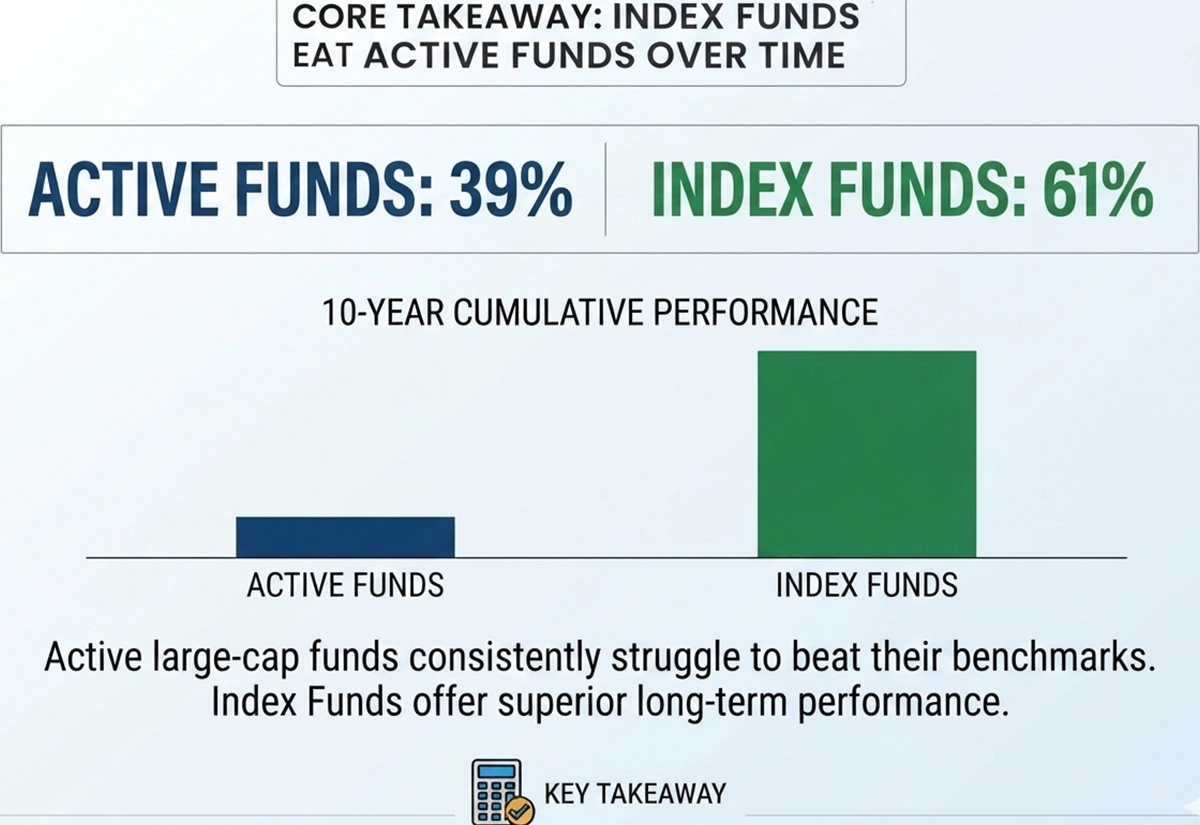
    It is important to realize that predicting the best large cap mutual funds is very difficult and one approach to address this has been to acknowledge the increasing preference for Index Funds and allocate monies in them. Index funds invest in the popular benchmarks like Sensex and Nifty and distribute your investments among different companies in the same proportion as in the benchmark.

    Index funds eliminate the need to predict the best large cap mutual funds

    Index funds eliminate the need to predict the best large cap mutual funds and saves you from incurring transaction costs such as exit loads and taxes when you jump from one fund to the other. Before you get started with investments in these funds, it is necessary to know if equity funds suit your risk appetite. Get in touch with your fee only financial planner and undertake a risk profiler exercise today to know your ideal asset allocation.

    What is more important than choosing best mutual funds?

    While most people are running after the best performing fund, they fail to do proper due diligence of their personal circumstances. Before you invest in Index Funds you needs to ask the below questions;

    What is my financial goal?

    It is important to know why you are investing. Most people invest just because some fund is giving the best returns. One needs to identify their goal; what is the time horizon they have? What it the present cost of the goal? How will inflation impact their goals? What is the likely future cost of the goal?

    What is the ideal asset allocation?

    The ideal asset allocation for an individual depends on factors like the risk profile, investment time horizon and investment preferences. If you goals are within 5 years; equities and equity mutual funds should be avoided as they are very volatile for short term periods. If you have longer periods to stay invested equities may be preferable, but the extent of equity allocation is dependent on your risk profile. Aggressive investors can allocate 80% – 90% of their investments in equity, but for most investors, investing 60% – 70% in equity even for longer periods would be most preferable.

    What are the Expected Returns?

    People chasing the best returns are fooled by marketing tactics which pick random data points showing phenomenal returns. They fail to understand that the long term performance records of mutual funds show an achievable return of 10% – 12%. For debt instruments it would safe to invest in instruments that deliver returns between 6% – 7%. People chasing superior returns in debt instruments have been punished by the poor quality papers leading to defaults and downgrades.

    Calendar Icon Book Your Free Introductory Call

    Recent Blogs

    7 Steps to Choose the Right Investment Products for Your Financial Goals

    Confused about how to choose investment products? Follow these 7 expert-backed steps to align your investments with your financial goals and risk profile.

    Learn More

    Investing During a Market Crash: What the Data Really Shows

    Should you invest during a stock market crash? See historical Sensex data on returns post-crash and learn why panic-selling hurts investors most.

    Learn More

    Dynamic Asset Allocation: What It Is & Why It Works

    What is dynamic asset allocation and how does it work? See how a P/E-based equity-debt strategy outperformed the Sensex by up to 250% since 1999.

    Learn More

    Understanding Wills: Elements, Types & Why They Matter

    What makes a will legally valid in India? Learn its essential elements, types, importance, and what happens to your estate if you die without one.

    Learn More

    Should You Prioritize Insurance Before Investing?

    Confused about whether to buy insurance or start investing first? Learn why risk management through life, health, and disability cover should come before investments.

    Learn More

    Are Index Funds the Right Choice for You?

    Wondering if index funds are right for you? Learn why chasing top-performing mutual funds fails and how index funds simplify long-term investing.

    Learn More

    Goals Based Investing vs Market Volatility: A Complete Guide

    How does a goals based investment approach help during market volatility? Learn why linking investments to your goals beats reacting to market swings.

    Learn More

    The Right Way to Calculate Your Life Insurance

    How much life insurance do you really need? Learn the Income Replacement and Need Based methods to calculate the right cover for your family.

    Learn More

    REITs Explained: Types, Taxation & How to Invest

    What are REITs and how do you invest in them in India? Learn types, tax rules, pros and cons before adding real estate exposure to your portfolio.

    Learn More

    Right Time to Buy Your Dream House: A Complete Guide

    When is the right time to buy your dream house in India? Explore 4 key factors — economic conditions, interest rates, market trends, and finances.

    Learn More

    The Right Time to Invest During a Market Correction

    We are all shaken, shaken by the ferocity of the fall in the stock markets. Never have we seen a correction of this magnitude in such a short period.


    Learn More

    Why Stock Markets Will Remain Volatile?

    The reason why stock markets fluctuate revolves around the theory of demand and supply. If more people want to buy a stock, its market price will increase.

    Learn More

    What Is a Super Top-Up Health Insurance Policy and How Does It Work?

    Base Policy and Super Top Up Policy are two commonly used options while taking Health Insurance. Health insurance is an important tool to safeguard your financial well-being against unexpected medical expenses. As medical treatments become more expensive

    Learn More

    Limited Pay vs Regular Pay — Which Life Insurance Premium Option Is Right for You?

    Limited pay vs regular pay – it is easy to get confused between options for your life insurance premium payment. While Life insurance plays a crucial role in securing the financial future of your loved ones.

    Learn More

    What Should You Do With Your Life Insurance Policy?

    In Indian families, pressure to buy traditional life insurance policies can be strong and multifaceted. Parents often play the “security card,” emphasizing the importance of safeguarding their child’s future and highlighting potential future burdens or painting a picture of an uncertain future without the policy.

    Learn More

    Comprehensive Guide on Home Loan Overdraft Facility

    Imagine a financial tool that combines the stability of a home loan with the flexibility of an overdraft account – that’s precisely what the Home Loan Overdraft Facility entails.

    Learn More

    How to Choose from Different Gold Investment Options

    Confused about gold investment options in India? From physical gold to SGBs, this guide compares costs, tax rules, and returns to help you make the right choice.

    Learn More

    Index Funds - Advantages, Risks & Suitability

    Index Funds are an investment instruments that are based on stock market indices like Sensex or Nifty. These funds are built using a pre-set basket of stocks from different sectors of the economy with predefined weights.

    Learn More

    Direct Funds vs Regular Funds - Are Direct Mutual Funds better ?

    Confused between direct and regular mutual funds? Compare expense ratios, NAV, and returns to find out which plan helps you grow your wealth long-term.

    Learn More

    SSY Interest Rates, Tax Benefits, & Withdrawal Rules

    Sukanya Samriddhi Yojana (SSY) is an initiative launched by the Government of India as part of its Beti Bachao, Beti Padhao campaign, (Save the Girl Child, Educate the Girl Child).

    Learn More

    7 Types of Financial Ratios to Assess your personal finance & ways to improve them

    Understanding the 7 types of financial ratios is a vital exercise that individuals should undertake to assess the state of their financial well-being.

    Learn More

    What Should you do with your 401K Account if you Move Back to India

    Moving back to your home country after years of working in the US is an exciting chapter. However, it also comes with its own set of financial considerations, especially when it comes to your US retirement savings.

    Learn More

    What Are ULIP Charges and How Do They Work

    Know about ULIP charges in India covering mortality, policy admin, switching, surrender, and guarantee fees to help you decide if ULIP is worth investing in.

    Learn More

    Key Features of NPS (National Pension Scheme)

    The National Pension Scheme is a government-sponsored retirement savings plan introduced in India in 2004. It provides a structured approach for individuals to build a retirement fund by making regular contributions.

    Learn More

    ESOPs vs RSUs vs ESPPs - Understand the 7 key differences

    In today's competitive Indian job market, companies are increasingly turning to equity compensation plans to attract and retain top talent.

    Learn More

    12 Risks of Investing ESOPs/RSUs/ESPPs

    Imagine your future self, financially secure thanks to a hefty chunk of your employer's stock, a reward for your dedication and hard work.

    Learn More

    What Should You Do With Your Life Insurance Policy Decision

    Confused about what should you do with your life insurance policy? In Indian families, pressure to buy traditional life insurance policies can be strong and multifaceted.

    Learn More

    5 Proven Ways to Build Stable Post Retirement Income in India

    Retirement brings major changes in income and life. Investments and savings can help you meet your needs, but a steady income is still essential for daily expenses and regular cash flow.

    Learn More

    12 Must Follow Financial Practices Before Moving Abroad

    When one is leaving the familiar shores of India for a new life abroad, it may be both exciting and daunting. It's exciting to pack up your bags and head out on a new adventure, but one of the biggest challenges you will face is getting used to a new financial environment.

    Learn More

    5 Reasons to Prefer a Fee-Only Financial Planner in India

    The term "financial planner" is used often and very loosely. In India, many people call themselves financial planners, the insurance agent, the mutual fund distributor,

    Learn More

    How do Financial Planners & Advisors Get Paid in India?

    SEBI (Securities Exchange Board of India), with its latest amendments to Registered Investment Adviser (RIA) Regulations, mandates that all registered financial planners can charge only on two bases. A Financial Planner can either charge a fee for financial planning or earn from distribution of financial products.

    Learn More

    How to Choose The Best Financial Advisor In India

    If you are confused about how to choose the best financial advisor in India, you can thank the Securities Exchange Board of India (SEBI).

    Learn More

    6 Reasons to Review Your Financial Plan for Better Financial Health

    Reviewing your financial plan matters as much as using a trusted navigation system. When you move forward without regular reviews, you risk heading in the wrong direction.

    Learn More

    SEBI's mandatory disclosure requirement

    View More
    WhatsApp
    Phone Call