
The Right Time to Invest During a Market Correction
Why Timing the Market Bottom Is Nearly Impossible?
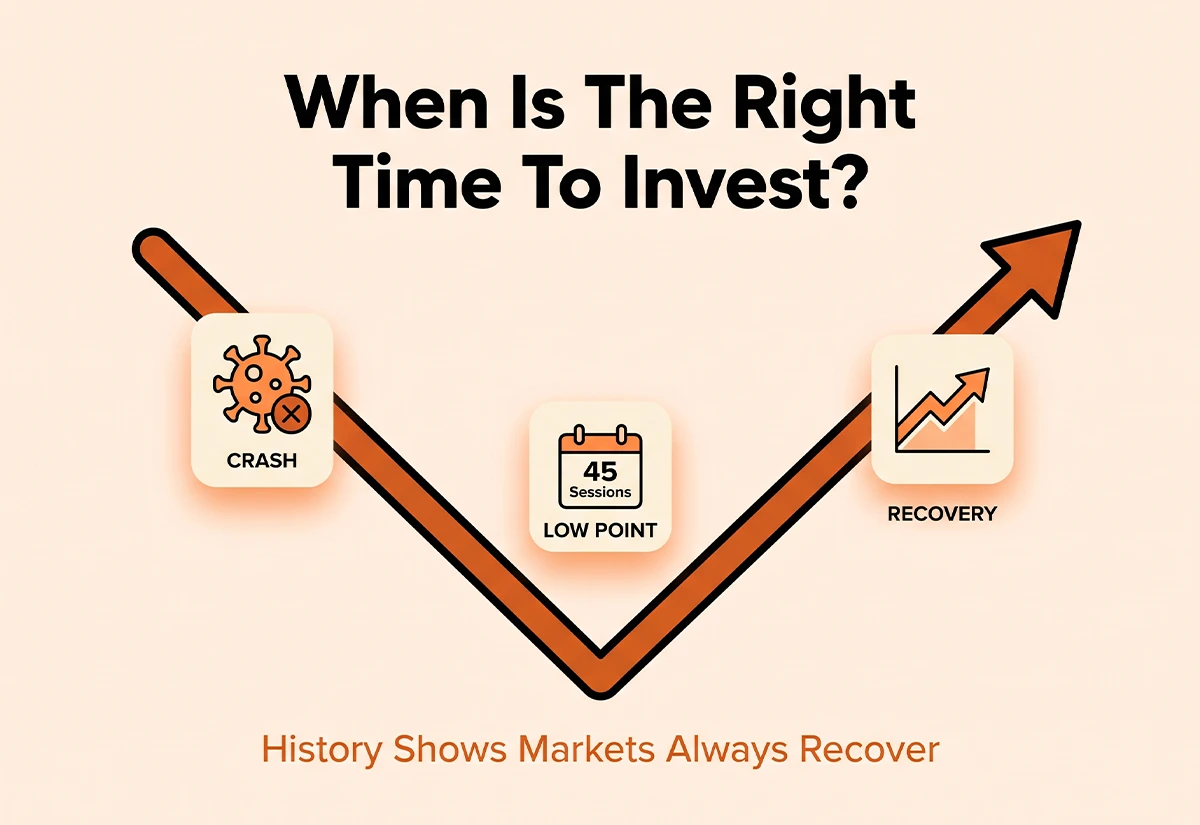
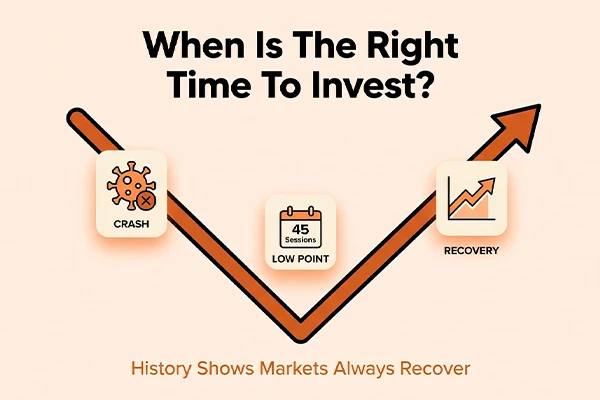
Image description
Title: When Is The Right Time To Invest? A V-shaped orange line falls from the upper left, bottoms out, and rises to an upward arrow on the right. Three labelled stages sit along it: CRASH (virus icon with a cross mark) on the falling side; LOW POINT (calendar icon reading 45 Sessions) near the bottom; RECOVERY (rising chart icon) on the rising side. Caption at the bottom: History Shows Markets Always Recover.
We are all shaken, shaken by the ferocity of the fall in the stock markets. Never have we seen a correction of this magnitude in such a short period. A correction of more than 35% within 45 trading sessions is unheard and is sending shockwaves to investors. While the virus will get contained over time, investors are not sure when and the extent of damage it can cause to the economy.
Sensing an opportunity to make great returns are another set of investors who know that, ‘this too shall pass’. They are aware that the economy will be back and the stock markets will follow. The question they are asking, ‘When is it the right time to invest in stocks markets?’
Let us look at the below charts of the past bear phase in stock markets.

Image description
Illustration of a stock market candlestick chart viewed by a man holding a tablet. The chart dips and fluctuates at first, then climbs strongly toward the upper right. Events are marked along it, from left to right: Economic Recession; Global Financial Crisis; High Inflation; Interest Rate Hike; Geopolitical Tensions; Economic Recovery. An arrow below the chart runs from 'Short Term' to 'Long Term'. On the right, a staircase rises to a green upward arrow, with steps labelled from bottom to top: Discipline; Consistency; SIP Investing; Phased Investing; Wealth Creation. The image conveys that markets recover from shocks over the long term and that steady investing habits build wealth.
Looking at the above graphs, it becomes clear that it is very difficult to predict the market bottoms and know exactly when to invest during market corrections. What is easier, though, is to ensure that you invest during these volatile times.
If you have been fully invested, be clam and be sure that this situation will pass. If you have cash or funds allocated for this purpose, ensure that you spread your investments over the next couple of weeks. It is important to keep emotions at check and follow a disciplined approach to invest over the next couple of weeks.
In the above graph we have plotted time (in years) on the horizontal axis and the percentage change every year on the vertical axis. We get to see a lot of fluctuations on both positive and negative sides which again showcase the volatile nature of the stock market.
With the Sensex being volatile in the short run, a longer term horizon shows a better picture. The below graph showing the return trajectory for 5 year periods from 1996 to 2020 makes it clear for us that equity investments are not suitable for shorter periods. One may end up with flat returns even over 5 year periods, but the returns for 10 year plus horizons give us higher probability to grow wealth. The annualized returns for the 25 year period being close to 11% p.a
A clear cut strategy for this purpose will help you tide over your emotions. For example, you could decide to stagger your investments in installments of 10% over the next ten weeks or you could go aggressive and invest 25% each in 4 equal installments. It is very important to consult your financial adviser before you pull the trigger to understand if this action aligns with your risk profile and financial goals.
The above chart tracks the Sensex from 1979 and makes it clear that although the markets have gone through turbulence with wars, financial scams, and economic slowdowns in the past, they have risen back and rewarded the ones who have stayed put and invested during these volatile times.
Get a FREE 30 mins consultation call with a SEBI Registered Fee Only Financial Planner to understand how a financial plan can help you achieve your financial goals and aspirations.
Schedule a Call