
12 Must Follow Financial Practices Before Moving Abroad
Table of Contents
12 Financial Planning Must-Dos Before Going Abroad

When one is leaving the familiar shores of India for a new life abroad, it may be both exciting and daunting. It's exciting to pack up your bags and head out on a new adventure, but one of the biggest challenges you will face is getting used to a new financial environment. Whether it's currency conversions or the legalities of being an NRI, this blog is your go-to guide for managing your finances with ease and simplicity.
The 182-Day Rule: Once you spend more than 182 days outside India during a financial year, your residency status officially changes to NRI. This triggers specific regulations regarding how you must hold bank accounts and manage investments in India.
12 Smart Financial Steps Before Moving Abroad from India
1. Convert Savings Accounts to NRO
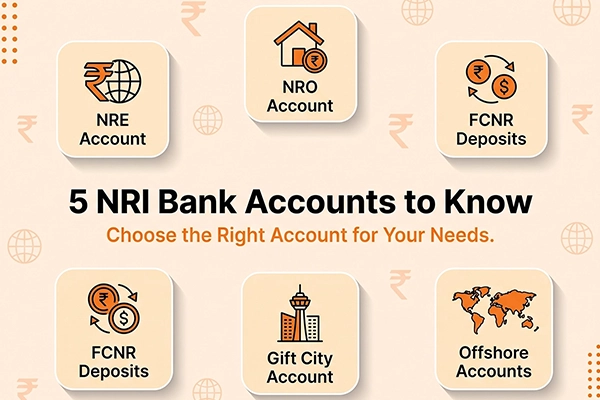
FEMA mandates that NRIs cannot hold regular resident savings accounts. Before leaving, consolidate your accounts and convert them to Non-Resident Ordinary (NRO) accounts.
- Purpose: Manage income earned in India (rent, dividends, pension).
- Taxation: Interest is subject to TDS (Tax Deducted at Source).
- Repatriation: Principal is generally restricted, though you can repatriate up to $1 million USD per year under specific RBI guidelines.
2. Open an NRE Account
A Non-Resident External (NRE) account is designed for the income you earn outside India.
- Currency: Held in Indian Rupees (INR), but funds are deposited in foreign currency.
- Tax Benefit: Interest earned in an NRE account is tax-free in India.
- Repatriability: Both principal and interest are fully and freely repatriable.
3. Manage Your FDs and RDs
Approaching the 182-day mark, you must decide the fate of your resident deposits:
- Option A : If you do not require immediate remittance from India and you are interested in continuing to receive Indian income, then this is the best – convert to NRO.
- Option B: Convert to NRE/FCNR: Tax free interest (NRE) / to protect against Rupee fluctuations (FCNR).
- Pro-Tip: The remittance limit of ₹7.5 lakh must be utilised in a judicious manner to prevent TCS (Tax Collected at Source) by breaking the remittance into two financial years.
4. Pay Down Your Debts
Keeping just one or two cards (optional): This is not a requirement but is suggested to avoid:
- Multiple Bills: Difficult to keep track of due to different time zones.
- Hidden Costs: High foreign transaction fees on Indian Cards.
- Safe from Fraud: The fewer cards, the less risk of being stolen or used without authorization.
5. Make a planned investment.
Pay off credit card and debt before relocating. This will help you make payments across borders without hassle, and keep your international cash flow in check and your Indian credit score in good standing.
6. Retain Life and Health Insurance
If you plan to return to India eventually, keep your existing policies active.
- Continuity: Avoids the need for new medical underwriting later in life.
- Pre-existing Conditions: Existing plans will continue to cover conditions that might be excluded from a new policy later.
7. Close Bank Lockers
Accessing a physical locker from overseas is difficult and expensive. Close them to save on annual maintenance fees and move your valuables to a secure box in your new country or leave them with a highly trusted contact.
8. Strategize Your PPF
You cannot open a new PPF account as an NRI, but you can continue contributing to an existing one. If PPF is part of your fixed-income strategy, ensure it is set up before your status changes.
9. Update KYC to NRI Status
This is a legal requirement. Inform your banks and investment houses of your change in status.
- Documents: You’ll likely need a copy of your passport, visa/work permit, and proof of your new overseas address.
- Advantages: Accounts will not be frozen and tax will be applied correctly.
10. Decrease Real Estate Exposure
Being a landlord in India from overseas can be challenging due to the need for distance management in repairs, tenants, and market fluctuations.
- Think: Consider Selling – Free up capital for your new life.
- For Property Management: If you maintain it, use a professional business to manage it.
11. Assign Power of Attorney (POA)
A Power of Attorney in India allows a trusted individual to make decisions for you in legal or financial transactions or when buying or selling property that needs to be physically present.
12. Get connected with a Professional
Going abroad is indeed a big life change. A cross-border tax and investment advisor, who is also a financial planner and registered with the Securities and Exchange Board of India (SEBI), can guide you through complicated cross-border taxation and investment options, ensuring your assets are growing in both countries.
Smart Financial Planning for Moving Abroad with Wealth Crafts
Adopting to living overseas entails major financial adjustments, which should be planned for and timely decisions made. Whether it is banking, tax laws, investments or insurance, every step is crucial to safeguarding your wealth and maintaining financial continuity in a new nation.
Good planning can prevent compliance problems, limit tax problems and keep you in better control of your funds, across borders. A structured approach also means that your savings and investments continue to perform as they should even after you change your residency status.
At Wealth Crafts, we help individuals and NRIs make these transitions simple and well planned through structured financial guidance and fee only advisory support as a NRI Financial Advisor